When Data Is Not Enough: How Forecaz combines AI and planning expertise to forecast city growth
Updated: Mar 3
KEY TAKEAWAYS:
Development Application/Permit data alone is too sparse and imbalanced to reliably train Machine Learning models for urban growth forecasting. Encoding urban planner expertise into Bayesian Network models and combining this with DA/Permit data addresses the gap and delivers 10% to 15% accuracy improvements over using either approach in isolation.
Random Forest models outperformed neural network alternatives by at least 20% accuracy in identifying development propensity, training on the full dataset in one to two seconds and offering clear interpretability, making them a practical choice for production forecasting systems.
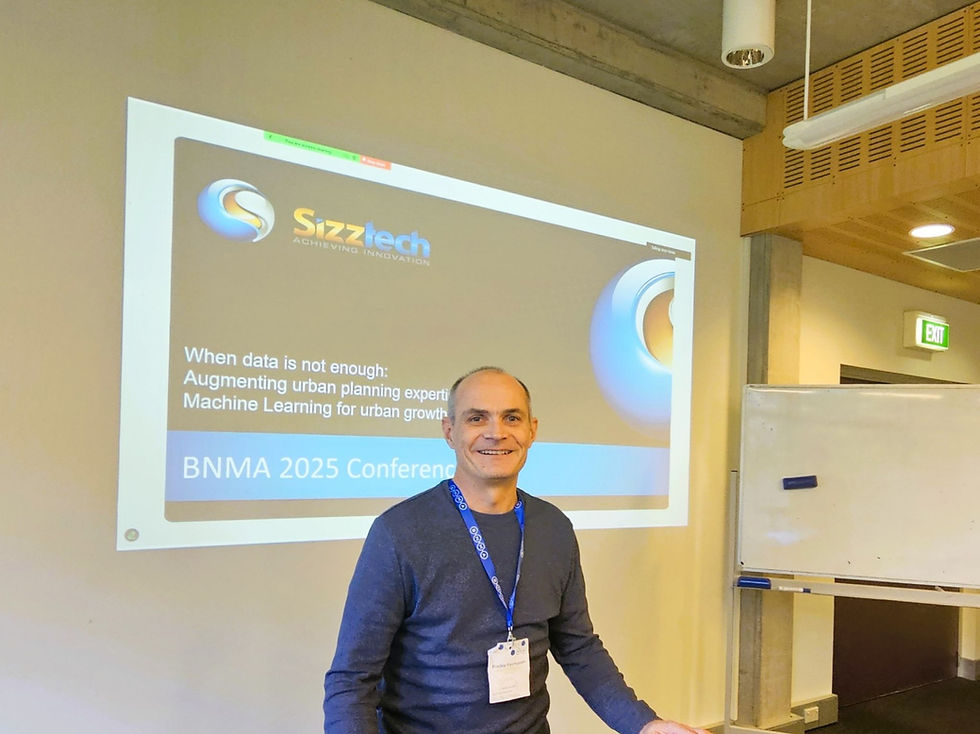
Forecaz CEO Bradley Rasmussen presented original research at the BNMA 2025 Conference hosted by the Bayesian Network Modelling Association and the University of Melbourne, showing how combining Bayesian Network models with Machine Learning produces more accurate urban growth forecasts than either method alone.
Understanding the Limits of Historical Data
Bradley Rasmussen took the stage at the BNMA 2025 Conference to present findings on a problem every urban growth modeller faces: historical development data alone is not enough to reliably predict where and when cities will grow.
The presentation, titled "When Data is Not Enough: Augmenting Urban Planning Expertise with Machine Learning for Urban Growth Forecasting," drew on the work Forecaz has performed building the Forecaz platform and addressed a fundamental gap in how urban growth models are typically built.
The Core Challenge: Predicting Development Propensity
The core challenge is predicting development propensity, the likelihood a property will be developed within a given timeframe. Development Applications and Permits (DA/Permits) are the natural data source for this, since approved development is what physically delivers urban growth. The problem is the data itself.
Limitations of DA/Permit Data
DA/Permits typically cover only 5% to 10% of developable properties. The skew is 75% to 80% toward residential development, and almost never includes refused or unfeasible applications. That missing data matters enormously for training accurate Machine Learning models.
Encoding Planner Expertise into Bayesian Network Models
To address this, Forecaz encoded urban planner expertise directly into Bayesian Network (BN) models. BN models are probabilistic graphical models commonly used in land use scenario planning. They allow planners to formalise their knowledge of the factors that drive development, things like land zoning, proximity to services, parcel size, site coverage, and ownership type, into a structured model. Forecaz built separate BN models for residential and non-residential development, each with their own set of relevant development factors.
Strengths and Weaknesses of BN Models
The BN models performed well at identifying properties with clear high or low development propensity. The weakness is in the middle of the distribution, where propensity is less certain. This is precisely where Machine Learning has the potential to add value.
Testing a Hybrid BN + Machine Learning Approach
Forecaz tested whether combining BN model outputs with DA/Permit data and feeding both into a Random Forest Machine Learning model produced better predictions. After evaluating multiple neural network architectures, which consistently struggled with under-learning due to limited training data, Random Forests emerged as the clear choice. They trained on the full dataset in one to two seconds, were resistant to over and under-fitting, required minimal optimisation, and provided transparency by identifying which features most influenced predictions.
Performance Testing and Results
Performance testing removed 30% of DA/Permits from the training data and measured whether the model developed a nearby property within 25, 50, or 100 metres of the withheld test cases. The results were consistent across both residential and non-residential development categories.
For non-residential development, the combined ML and BN approach achieved 74.8% accuracy within 100 metres by 2031, compared to 62.6% using the BN model alone. For residential development, the combined approach reached 86.2% accuracy within 100 metres by 2031, compared to 82.9% using BN alone. Across both categories, the hybrid approach delivered a 10% to 15% performance improvement over the BN model on its own, with the largest gains seen in non-residential forecasting.
A Conference That Encouraged Collaboration
The conference itself was a small gathering of under 30 attendees, hosted by the Bayesian Network Modelling Association and the University of Melbourne. Bradley noted that the intimate format created real one-on-one connections with researchers and practitioners working on related problems.
Looking Ahead: Opportunities for Research Partnerships
Forecaz is open to partnering with researchers to extend this work further. The company sees the hybrid BN and Machine Learning approach as a practical path toward more accurate, more transparent urban growth forecasting at scale.
Bradley’s post on LinkedIn.